
What to know about peptides for health

Peptides are smaller versions of proteins. They may provide pro-aging support, anti-inflammatory, or muscle-building properties. However, more research is still necessary to understand their risks and benefits.

Recent research indicates that some types of peptides could have a beneficial role in slowing down the aging process, reducing inflammation, and destroying microbes.

People may confuse peptides with proteins. Both proteins and peptides are made up of amino acids, but peptides contain far fewer amino acids than proteins. Like proteins, peptides are naturally present in foods.

Due to the potential health benefits of peptides, many supplements are available that contain peptides that manufacturers have derived either from food or made synthetically.

Some of the most popular peptides include collagen peptides for anti-aging and skin health, and creatine peptide supplements for building muscle and enhancing athletic performance.

What are peptides?
Oleg Breslavtsev/Getty Images

PeptidesTrusted Source are short strings of amino acids, typically comprising 2 to 50 amino acidsTrusted Source. Amino acids are also the building blocks of proteins, but proteins contain more.

Peptides may be easier for the body to absorb than proteins because they are smaller and more broken down than proteins. They can more easily penetrate the skin and intestines, which helps them to enter the bloodstream more quickly.

The peptides in supplements may come fromTrusted Source plant or animal sources of protein, including:

  • eggs
  • milk
  • meat
  • fish and shellfish
  • beans and lentils
  • soy
  • oats
  • flaxseed
  • hemp seeds
  • wheat

Scientists are most interested in bioactive peptides, or those that have a beneficial effect on the body and may positively impact human health. Different bioactive peptides have different properties. The effects they have on the body depend on the sequence of amino acids they contain.

Some of the most common peptide supplements available are collagen peptides, which may benefit skin health and reverse the effects of aging, and creatine peptides, which may build strength and muscle mass.

Some people may take other peptides and peptide hormones to enhance athletic activity. However, the World Anti-Doping Agency have banned many of these, including follistatin, a peptide that increases muscle growth.

Uses and benefits

Research indicates that bioactive peptides mayTrusted Source:

People often use peptides to try to achieve the following effects:

Slow down the aging process

Collagen is a protein in the skin, hair, and nails. Collagen peptides are broken down collagen proteins that the body can absorb more easily. Taking collagen peptides may improve skin health and slow the aging process.

A 2022 review indicates that taking collagen supplements can contribute towards reducing or delaying skin aging. Similarly, a 2023 systematic review and meta-analysis also suggests that collagen supplements can have positive effects on skin health. However, both reviews highlight that more research is still necessary.

Additionally, other research suggests that peptide complexes can also benefit skin health and provide anti wrinkle benefits.

Improve wound healing

As collagen is a vital component of healthy skin, collagen peptides may facilitate faster wound healing. Although more research is necessary, a 2021 review highlights the potential of collagen to promote wound healing.

Additionally, ongoing research is investigating the potential of antimicrobial peptides. These refers a class of peptide which may possess a wide range of inhibitory effects against bacteria, fungi, parasites and viruses. They may provide a promising alternative to antibiotics, which may not be effective against certain bacteria due to antibiotic resistance.

Prevent age-related bone loss

Some research suggests that a moderate intake of collagen peptides can help to increase bone mass. This may be beneficial for individuals with conditions that impact bone density, such as osteoporosis.

A 2018 studyTrusted Source notes that supplementing collagen peptides can increase bone mineral density and improve bone markers in postmenopausal people with reduced bone mineral density. A follow up study in 2021Trusted Source found that the long-term use of collagen peptide supplements can help to significantly increase bone mineral density.

Build strength and muscle mass

Some research indicates that peptide supplements may help increase muscle mass and strength. For example, a 2019 study suggests that combining peptide supplements with resistance exercise training is more effective for increasing muscle strength than exercise alone. Similarly, a 2022 study also indicates that combining exercise and peptide supplements can help increase muscle mass and strength.

Additionally, a group of peptides known as growth hormone secretagogues (GHS)Trusted Source, could help treat conditions that involve muscle wasting. These peptides work by stimulating the production and release of human growth hormone.

Side effects

For healthy individuals, peptide supplements are unlikely to cause serious side effects because they are similar to the peptides present in everyday foods.

However, it is important to note that research into peptides is still ongoing and the United States Food and Drug Administration (FDA) do not regulate supplements in the same way they do medications.

As a result, people should exercise caution when taking any supplements. It is advisable to consult a qualified healthcare provider before taking any peptide supplements. Those who are pregnant, breastfeeding, taking medications, or living with a medical condition should avoid using peptides until they contact doctor.

How to use

The timing and dose of peptide supplements will vary, depending on the type and brand.

Always follow the package instructions when taking peptide supplements or using topical peptide creams or lotions. Never exceed the recommended serving size. Discontinue use and consult a doctor if adverse reactions occur.

Summary

Peptides are naturally present in protein-rich foods. It is not necessary to take peptide supplements or use topical sources of peptides. However, some people may wish to use peptides with the aim of slowing down the aging process, or helping to build muscle and strength.

Currently, there is still limited evidence to indicate that these products are effective, and much more research is necessary to assess their efficacy and safety thoroughly.

Research into peptides is in the early stages, and in the future, scientists may discover health benefits of different types of peptides. Until then, people should exercise caution when taking any supplement and discuss the potential benefits and risks with a doctor beforehand.

Last medically reviewed on April 1, 2025

Source :

Call to avoid buying fake versions of Ozempic and Mounjaro

Monday, November 11, 2024

The South African Health Products Regulatory Authority (SAHPRA) has expressed concern at the increasing presence of counterfeit Glucagon-like Peptide (GLP-1) products, such as Ozempic, on the local market.

According to SAHPRA, GLP-1-containing products, like Ozempic, which help lower blood sugar levels and promote weight loss, are being made available to the public through websites, social media, and other informal channels.

“These pose a health risk to the public. SAHPRA cautions the public to not purchase and/or consume such products as their safety, efficacy, and quality have not been assessed.”

SAHPRA has reported an increase in suspected counterfeit Ozempic, chemically known as semaglutide, which is one of the registered products containing GLP-1 agonists from Novo Nordisk.

According to the watchdog, Ozempic in South Africa is registered under two presentations of pre-filled injectable pens, namely 0.25 mg and 0.5 mg/dose pen and 1 mg/dose pen.

“Ozempic is registered in South Africa for the treatment of adults with type 2 diabetes to reduce blood sugar levels for the treatment of adults with insufficiently controlled type 2 diabetes mellitus as an adjunct to diet and exercise.”

It is also approved to reduce the risk of major cardiovascular events, such as heart attack, stroke, or death, in adults with type 2 diabetes who have known heart disease.

“Ozempic is not registered in South Africa for weight management,” said the authority.

Mounjaro (tirzepatide), developed by Eli Lilly and Company, is also gaining attention in South Africa. It is available in pre-filled pens that come in a single dosage, containing either 2.5 mg, 5 mg, 7.5 mg, 10 mg, 12.5 mg, or 15 mg in a 0.5 ml solution for injection.

Mounjaro is indicated for treating type 2 diabetes mellitus but has not yet been imported into and placed on the market in South Africa through Eli Lilly and Company distribution channels.

Just like Ozempic, the watchdog stated that Mounjaro is not approved in South Africa for weight management.

“The complexity of compounding GLP-1 agonists, which are sterile medicines containing complex active substances poses a public health and safety risk.

“The risk associated with compounded medicines containing GLP-1 agonists are posed by the absence of the evaluation of these medicines by SAHPRA and the unknown nature and safety of ingredients used in compounding.”

Compounded products that claim to contain semaglutide have not been verified or evaluated by SAHPRA to determine if the active pharmaceutical ingredient is identical to the registered one, as required by the Medicines Act.

“Therefore, it maybe substandard and pose a risk to those using them,” said SAHPRA, adding  that the medicine using an active ingredient that is not contained in a product registered with SAHPRA is illegal in terms of the requirements of the Medicines and Related Substances Act.

“The public is urged to purchase only SAHPRA-registered products containing GLP-1 agonists, considering these risks.”

According to Section 29 of the Medicines and Related Substances Act, a person who commits an offence will be held criminally liable, and applicable penalties will be enforced.

SAHPRA CEO, Dr Boitumelo Semete-Makokotlela, stressed that safeguarding the well-being of the South African public remains a primary concern for the regulatory authority.

“SAHPRA is monitoring the supply chain as well as the online platforms for unregistered, substandard, and falsified medicines containing or claiming to contain semaglutide. We are also investigating any contraventions relating to the Medicines and Related Substances,” said Dr Semete-Makokotlela.

The public is urged to report any suspected products falsely claiming to be sold as Ozempic or Mounjaro.

Citizens are urged to report through these whistle-blower platforms, SAHPRA’s 24-hour hotline 0800 204 307, or via https://bit.ly/3nrku5t. – SAnews.gov.za

More reading : https://www.sanews.gov.za/south-africa/call-avoid-buying-fake-versions-ozempic-and-mounjaro

CSIR launches Africa’s first microencapsulation facility to boost local health, cosmetic innovation

The Council for Scientific and Industrial Research (CSIR) has launched a new facility in Pretoria that will, for the first time, help local manufacturers develop their own microencapsulation technologies on home soil. Microencapsulation is a way of protecting sensitive components in health and cosmetic products, such as probiotics and essential oils, thereby improving shelf-life and efficacy.

The new Supercritical Carbon Dioxide Encapsulation Facility formally welcomed industry partners and government officials on 17 October 2025, following an investment of R25.9 million by the Department of Science, Technology and Innovation (DSTI).

Facility
The CSIR’s new Supercritical Carbon Dioxide Encapsulation Facility formally welcomed industry partners and government officials on 17 October 2025, following an investment of R25.9 million by the Department of Science, Technology and Innovation. The facility brings key microencapsulation technology, which protects sensitive ingredients in probiotics, essential oils and other health and cosmetic products, to Africa for the first time.
The new facility will boost South Africa’s innovation and manufacturing sectors, enabling high-value, sustainable production, while supporting localisation, job creation and Africa’s growing bio-based economy.
Speaking at the launch event, CSIR Chief Executive Officer Dr Thulani Dlamini, said the facility “opens the door for local researchers, entrepreneurs and manufacturers to test, refine and scale their innovations right here at home, reducing reliance on international facilities and accelerating the path from laboratory to market.”
He was referring to innovations in product formulations that use supercritical carbon dioxide (CO2) to create microcapsules that protect delicate ingredients. CO2 used in this microencapsulation process is not in gas or liquid form, but rather somewhere in between, in the so-called supercritical fluid state of matter.
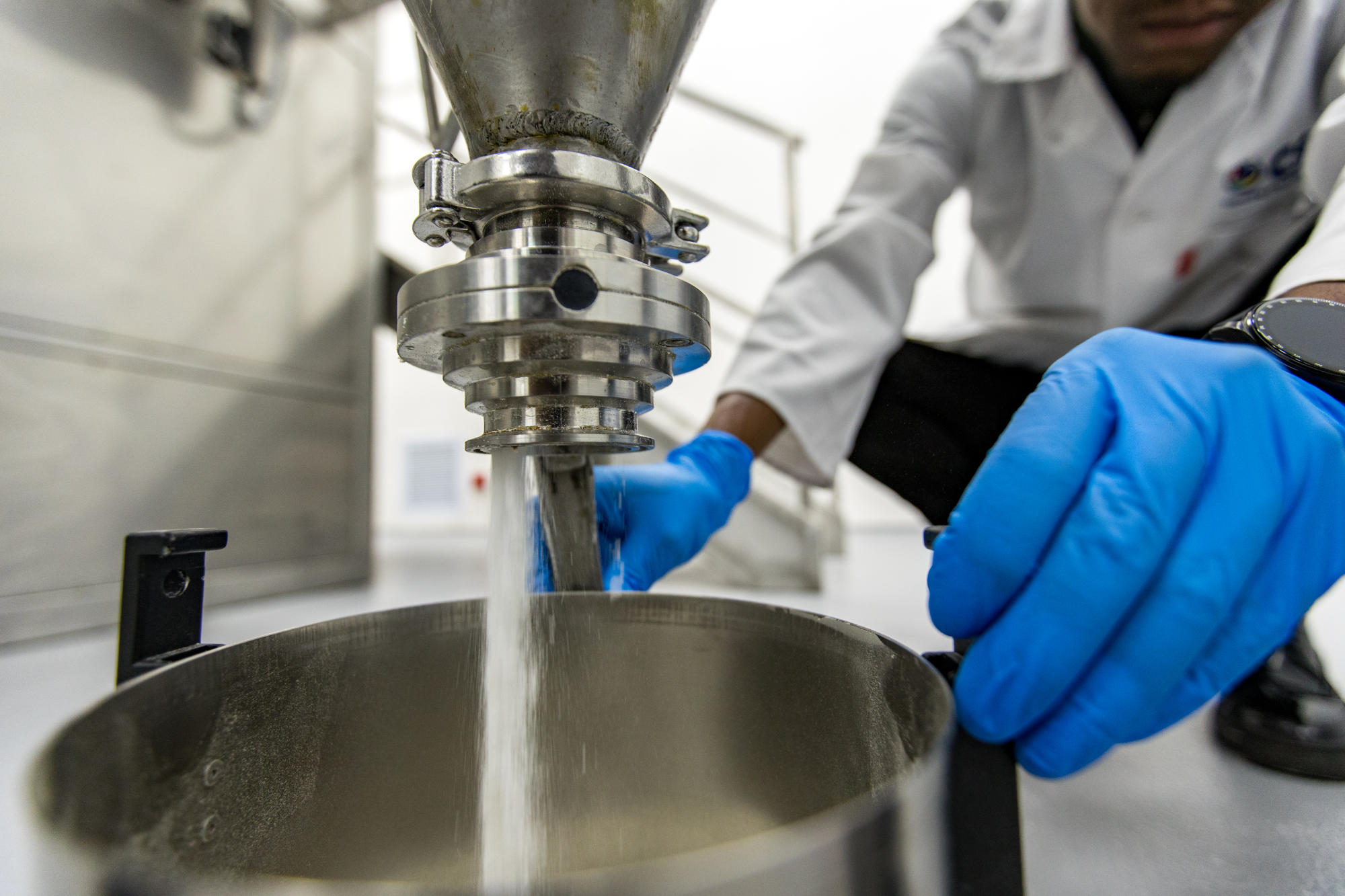
The CSIR’s Dr Philip Labuschagne said the process works by first dissolving supercritical carbon dioxide into a mixture of active ingredients and coating materials. The solution is then rapidly sprayed through a nozzle, releasing CO2 for later reuse, producing a fine powder of microcapsules (the active ingredient, encapsulated within the coating material).
“In your final powder product, you get tiny particle sizes of between 10 and 100 microns, and your active ingredient, whether it is a vitamin or even an oily liquid, is then dispersed within the particles,” he said.
 particles spherical particles particles
Scanning electron microscope images of microparticles produced using supercritical carbon dioxide. At the CSIR’s new facility, local cosmetic and health companies can now develop their own new product formulations to protect sensitive ingredients, thereby improving shelf-life, efficacy and stability. 
Labuschagne said products that could benefit from a supercritical CO2-based encapsulation technology include nutritional health supplements that are sensitive to oxygen, moisture, heat or stomach acid, such as probiotics, certain phytochemicals and volatile essential oils or plant extracts that evaporate easily.
Adelia Pimentel, executive director of the Cosmetic, Toiletry and Fragrance Association of South Africa, said during the launch that her industry body foresees several benefits of microencapsulation for local businesses and consumers, including better product stability, efficacy and shelf-life.
“The specific types of companies that will benefit from this particular facility would be anti-ageing and skincare brands,” said Pimentel, adding that the technology will boost innovation in fragrance, personal care, sensitive skin, make-up and other premium products.
“And then, of course, the sustainability and safety factor is always something that is important,” she said.
Labuschagne explained that the microencapsulation process requires no toxic organic solvents and takes place at relatively low temperatures, like 30 degrees Celsius. “It’s really a green and safe process, and most of the carbon dioxide, which is sourced and recovered from waste processes, is recycled back into the system,” he said.
facility Facility
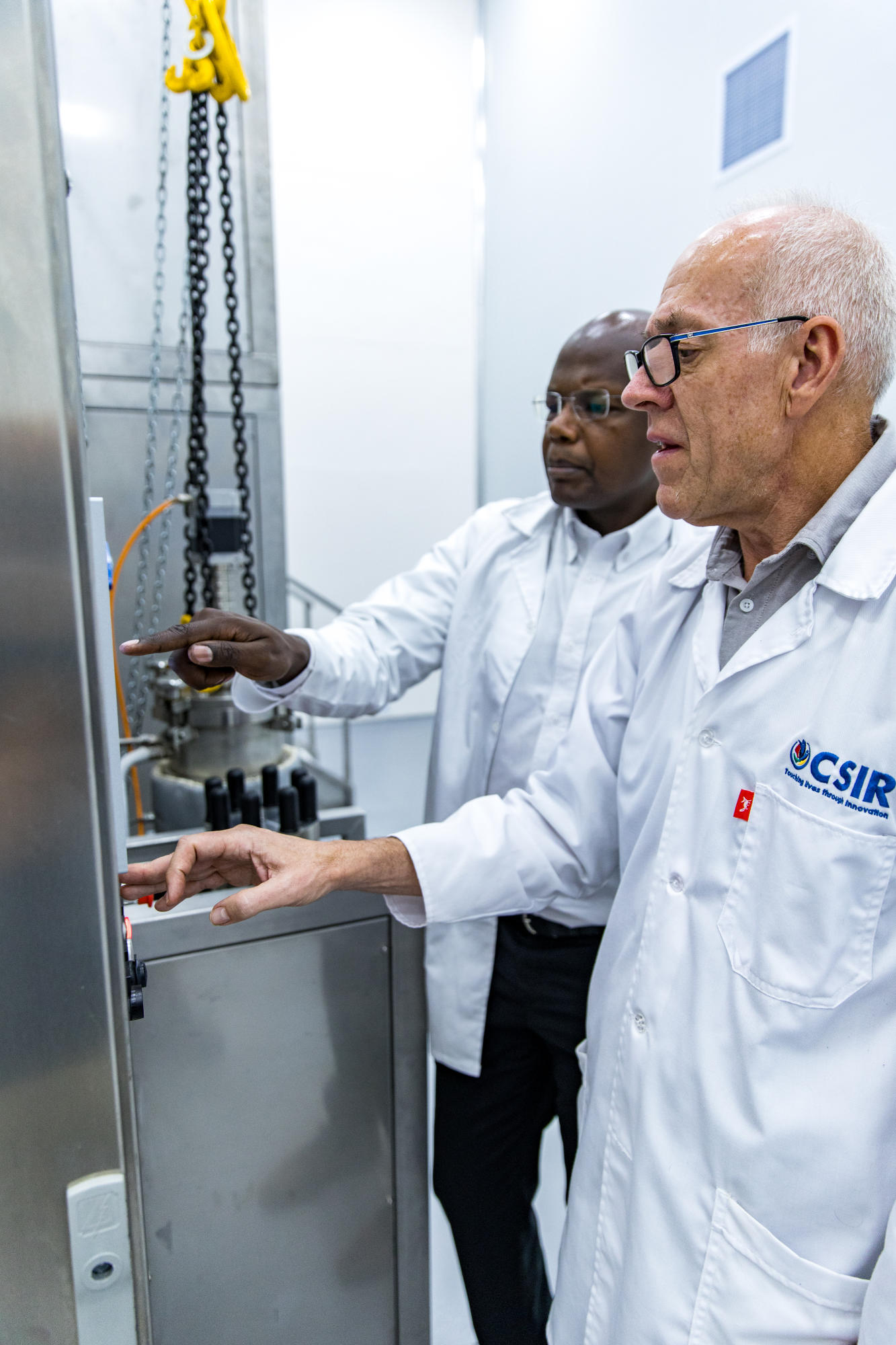
The CSIR’s Dr Philip Labuschagne (right) and the CEO of local gut health supplement business Velobiotics, Dr Chomba Chuma, discuss the microencapsulation of probiotics at the CSIR’s new Supercritical Carbon Dioxide Encapsulation Facility. 
Local gut health supplement business Velobiotics already uses CSIR’s facilities to produce microencapsulated formulations of probiotics. The process ensures that their products can survive the highly acidic stomach environment on their way to the intestines, where they are active.
CSIR researchers used a scanning electron microscope to verify the success of the microencapsulation process and checked that the final powder product can withstand the level of acidity (a pH of about two) encountered in the stomach.
“The CSIR is one of the biggest stakeholders we have, because this facility is the only one available in Africa,” said Velobiotics CEO, Dr Chomba Chuma, who now sees several of his company’s gut health products on major retailers’ shelves.
In his view, the new facility is a “beacon of African excellence” and a “launchpad for African biotech.”
“I want to thank the CSIR for believing in innovation, and the DSTI for supporting it,” said Chuma. He also said that without the CSIR’s scientific support, scaling his business would have been unaffordable.
facility
Supercritical carbon dioxide encapsulation technology yields a fine powder of microencapsulated product. First, supercritical carbon dioxide is dissolved in a mixture of active ingredients and coating materials. The solution is then rapidly sprayed through a nozzle, releasing the carbon dioxide for later reuse. Products that could benefit from this microencapsulation technology include probiotics or nutritional supplements that could be vulnerable to stomach acid, and volatile essential oils or plant extracts that evaporate easily. 
DSTI Director-General Dr Mlungisi Cele also addressed the media and industry representatives. “We see the launch of this facility as an important step in South Africa’s development of new high-tech industries to support manufacturing, which remains a key priority for our economy,” he said.
Nontombi Maseko, Director of Innovation and Technology at the Department of Trade and Industry, added that this facility will help anchor small to medium enterprises, enabling them to build from the ground up. She said her department offers incentives to further support such businesses in developing and commercialising new technologies.
-ENDS-
Issued by CSIR
For enquiries, contact:
Media enquiries:
Phetolo Phatsibi
Media practitioner
pp[email protected] or 081 396 8871
About the CSIR:
The CSIR, an entity of the Ministry of Science, Technology and Innovation, is one of Africa’s leading organisations in scientific and technology research, development and implementation. Constituted by an Act of Parliament in 1945 as a science council, the CSIR undertakes directed and multidisciplinary research and technological innovation, as well as industrial and scientific development, to improve the quality of life of all South Africans.
This year, the CSIR celebrates 80 years of touching lives through innovation. For more information, visit www.csir.co.za

Free Delivery

Free delivery nationwide in South Africa for qualifying orders

Highly qualified experienced Whatsapp support

Our support centers are manned by the most knowledgeable and experienced peptide users and professionals in the country.

Secure Checkout

100% Protected payment method facilitated by PayFlex

Copyright © 2026 Peptides Africa. All Rights Reserved.

Our Payment Partners :

Add to cart